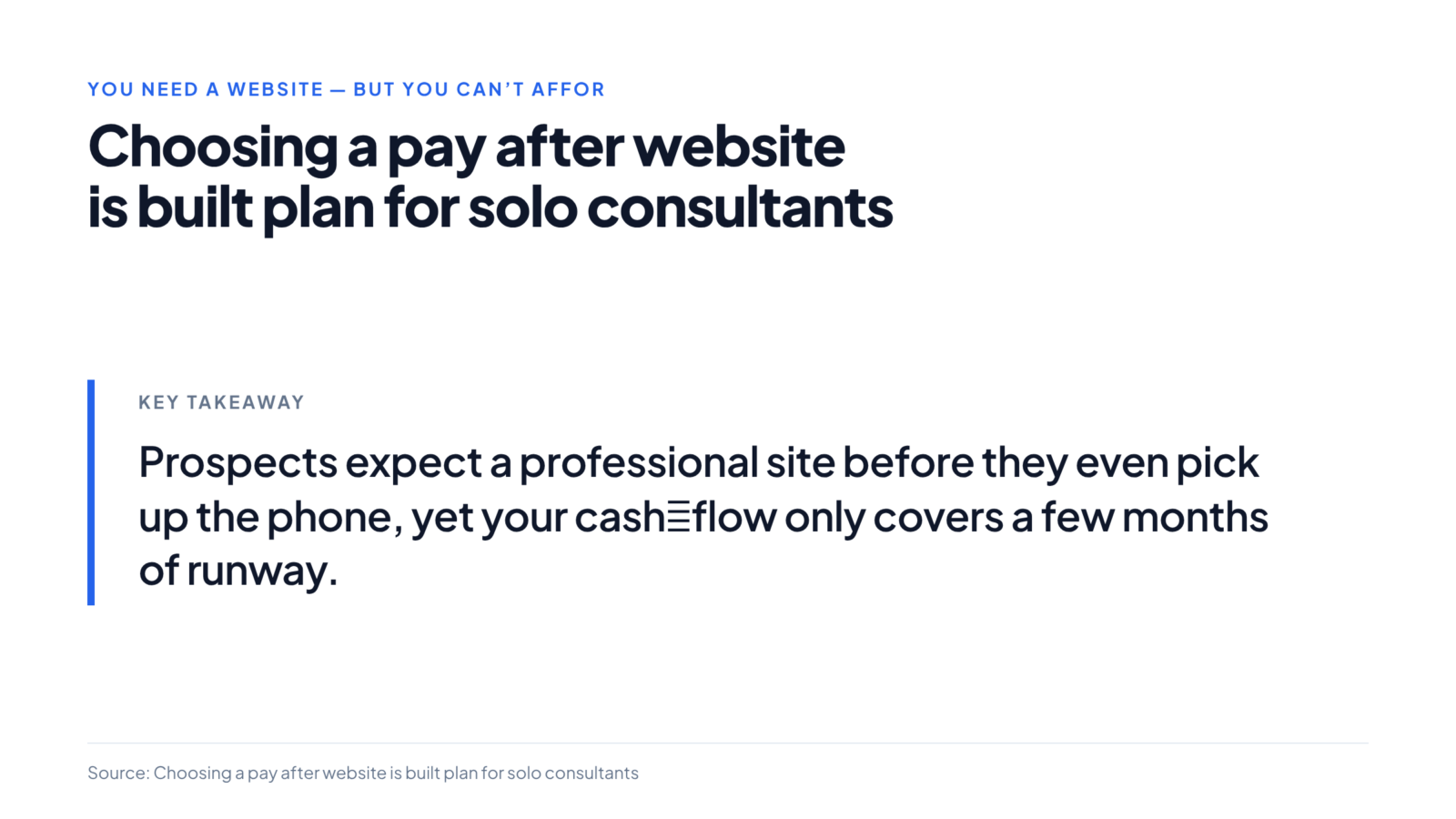
You Need a Website — But You Can’t Afford a Large Up‑Front Bill
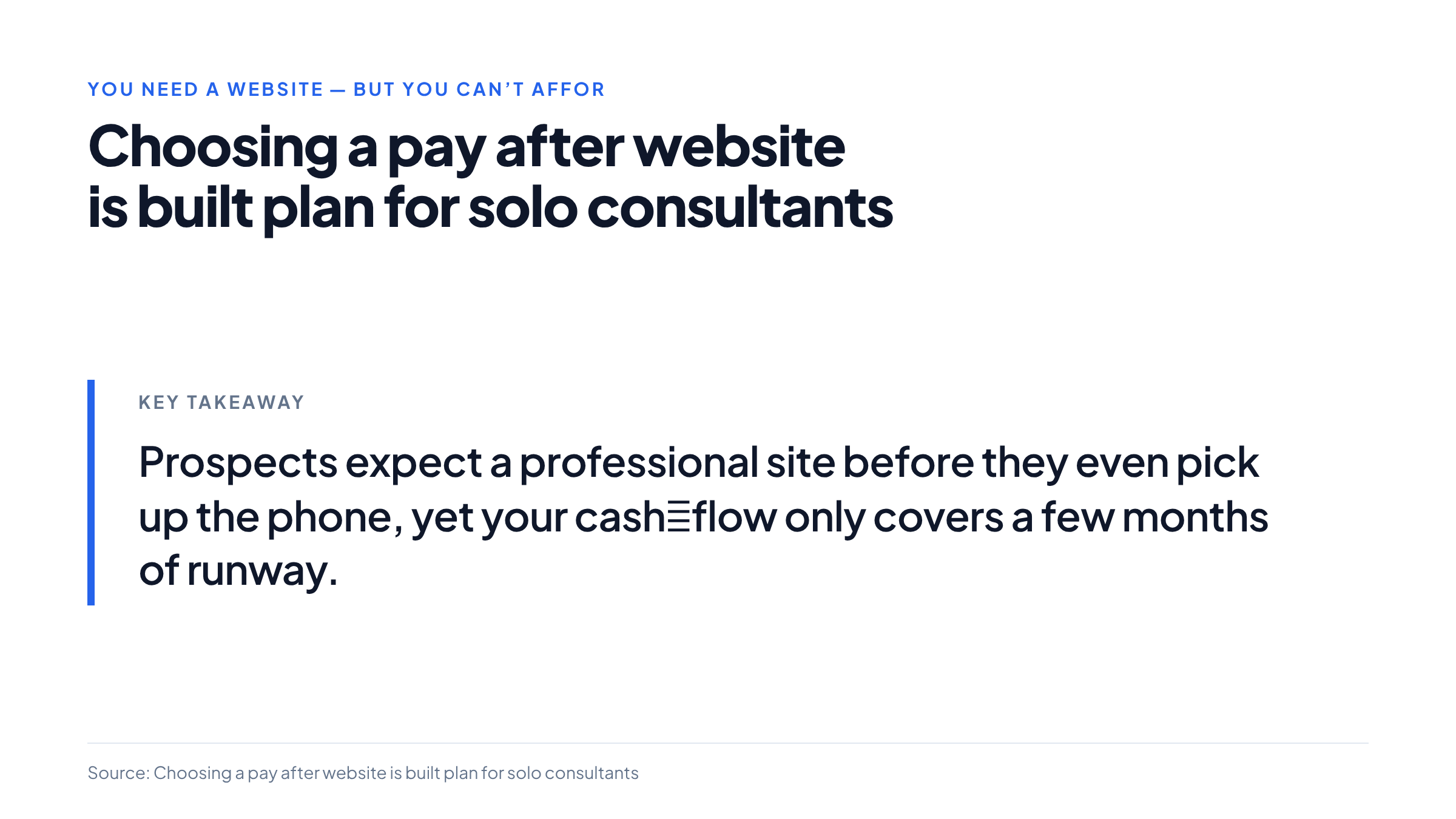
You run a solo‑consulting practice. Prospects expect a professional site before they even pick up the phone, yet your cash‑flow only covers a few months of runway. The decision you face is how you will pay for the site:
-
a traditional up‑front or milestone contract,
-
a “pay‑monthly” subscription service,
-
a milestone‑escrow arrangement, or
-
an AI‑generated rent‑to‑own model that shares early revenue.
Each option moves risk, ownership, and ongoing cost in a different direction. The guide below walks you through the mechanics, trade‑offs, and contract safeguards you need before you sign anything.
1. Why Deferred‑Payment Models Are Appearing Now
-
Cash‑flow pressure – Small businesses often operate month‑to‑month. A large lump‑sum can force you to postpone marketing, inventory, or payroll.
-
Service‑style SaaS influence – Platforms that bundle hosting, SEO tools, and support into a single monthly line‑item have shown that a website can be treated as an ongoing service rather than a one‑off deliverable. This has encouraged traditional agencies to experiment with deferred‑payment structures.
2. Common Payment Structures
| Structure | When Money Moves | What You Receive at Each Point |
|---|---|---|
| Up‑front | Before any work starts | Full ownership immediately; no further obligations |
| Milestone escrow | After each agreed milestone (wireframe, design mock‑up, beta launch) | Access to deliverables for review; escrow holds funds until you approve |
| Final‑payment only | After final delivery and acceptance test | Full site handed over; you can withhold payment if acceptance criteria aren’t met【S1】 |
| Pay‑monthly subscription | Ongoing, usually monthly | Continuous hosting, updates, and support; agency often retains source files |
| AI rent‑to‑own | No upfront fee; revenue‑share or lease‑to‑own | AI‑generated site, domain, and leads; option to buy the asset after a set period (revenue‑share often 30 %–50 % of monthly leads) |
The milestone‑escrow model is the most balanced for risk‑averse owners: you release money only when you see tangible progress, yet the agency still has cash to keep the project moving.
3. What a “Pay‑Monthly” Site Actually Gives You
A growing niche of agencies markets “Pay Monthly Websites” as a solution for cash‑strapped businesses. One provider describes the offering as follows:
“For many businesses, the biggest obstacle to launching a great website isn’t deciding whether they need one—it’s finding the budget to pay for it upfront.”【S2】
The promise is not just a payment schedule; it bundles ongoing support, SEO foundations, and a single point of contact. The key benefits are:
-
Predictable expense – a fixed monthly fee that can be budgeted like any other operating cost.
-
Continuous improvement – the agency has an incentive to keep the site performant because they receive the fee each month.
-
Managed‑service feel – the agency often retains the codebase, meaning you get a “service” rather than a hand‑off product.
Trade‑off: Partial ownership. Many providers keep the source files on their servers and may require a termination fee if you decide to move the site elsewhere. Always ask for a clear exit clause that specifies the cost (if any) to transfer the site and domain.
4. AI‑Built, Rent‑to‑Own Sites – A Hybrid Model
AI‑driven website builders have introduced a rent‑to‑own model that blends deferred payment with revenue sharing. A recent tutorial shows a creator building a “rank‑and‑rent” site that generates £300–£3,000 per month in leads while the builder retains ownership of the domain and the site itself【S3】.
Typical workflow
1. AI generates a site using a template tuned for a local service (e.g., pool‑cleaners‑dallas.com).
2. Builder hosts the site and runs the SEO campaign.
3. Client receives leads and pays the builder a monthly royalty (often 30 %–50 % of revenue).
4. After a pre‑agreed period (e.g., 12 months) or once a revenue target is hit, the client can buy out the site for a lump‑sum.
When it makes sense – you have no technical staff, you’re comfortable sharing a slice of early revenue, and you want a site that can start earning while you focus on core work.
When it doesn’t – you need full control over branding, or you cannot guarantee a steady flow of leads to cover the royalty.
5. Setting Up a Milestone‑Escrow Arrangement (Brief How‑To)
- Define milestones – break the project into clear stages (e.g., wireframes, design mock‑up, beta launch, final delivery).
- Choose an escrow provider – many online platforms (e.g., escrow.com) allow you to create a payment account that releases funds only after you approve each milestone.
- Draft acceptance criteria – for each milestone, list the deliverables and quality checks that must be satisfied before release.
- Load the first payment – typically a deposit of 20 %–30 % of the total contract value.
- Release funds incrementally – as each milestone passes your acceptance test, instruct the escrow service to release the corresponding amount.
Using escrow protects both parties: the agency gets cash to continue work, and you retain leverage until you see the promised output.
6. Red Flags and Contract Safeguards
Even a well‑intentioned “pay‑after” deal can go sour if the contract is vague. Below are the most common pitfalls and the clauses you should insist on:
| Red Flag | Why It Matters | Safeguard Clause |
|---|---|---|
| No clear acceptance criteria | You may be forced to sign off on a half‑finished site. | Acceptance Test: “Client shall have 10 business days to test the site against the functional specification. Final payment is contingent on passing this test.” |
| Agency retains source files indefinitely | Future migrations become costly or impossible. | Source Transfer: “Upon final payment, Agency shall deliver all source code, design assets, and domain credentials at no additional charge.” |
| Only a deposit, no escrow | Agency could disappear after receiving the deposit. | Escrow: “All milestone payments shall be held in a third‑party escrow account and released only after written acceptance of each deliverable.” |
| Revenue‑share without audit rights | You cannot verify royalty calculations. | Audit Rights: “Client may request a quarterly audit of revenue reports, with reasonable notice of 15 days.” |
| Indefinite support obligations | You may be locked into a costly support contract. | Support Term: “Agency shall provide bug‑fix support for 90 days post‑launch; any additional support will be billed at £X per hour.” |
If a vendor balks at any of these, treat it as a negotiation lever rather than a deal‑breaker—most agencies will adjust language to close a sale.
7. Comparing Total Cost of Ownership (TCO)
TCO includes direct fees, ongoing subscription or royalty payments, hosting, maintenance, and potential exit costs. The table below illustrates a simplified 12‑month picture for a typical small‑business site (≈10 pages, basic e‑commerce integration). Figures are illustrative; actual fees vary by provider.
| Model | Up‑front fee | Monthly ongoing cost | Estimated 12‑month TCO | Ownership at 12 mo |
|---|---|---|---|---|
| Up‑front | £3,000 | £0 (hosting ~£20/mo) | £3,240 | Full |
| Milestone escrow (30 % deposit, 70 % on delivery) | £900 + £2,100 | £0 (hosting ~£20/mo) | £3,240 | Full |
| Pay‑monthly subscription | £0 | £120 (incl. hosting & support) | £1,440 | Partial – agency holds source |
| AI rent‑to‑own | £0 | 40 % of revenue (assume £800/mo) = £320 | £3,840 (including royalty) | Partial – buy‑out option after 12 mo (£2,000) |
The subscription model looks cheapest in the short term, but you sacrifice full ownership. The AI rent‑to‑own model can become expensive if the site performs well, yet it offers a path to eventual ownership without a large upfront outlay.
8. Decision‑Aid: Payment‑Plan Selector
Copy the table below into a spreadsheet or a notebook. Rate each factor on a scale of 1 (low) to 5 (high), then add the scores. The total points map to a recommended payment model.
| Situation factor | Description | Score (1‑5) |
|---|---|---|
| Cash‑flow flexibility | Ability to defer a large payment | |
| Need for ongoing support | Preference for a single vendor handling updates, security patches, SEO | |
| Risk tolerance | Comfort with paying only after you see results | |
| Desire for full ownership | Importance of holding all source files and domain outright | |
| Willingness to share early revenue | Openness to royalty or rent‑to‑own arrangements |
Recommendation matrix
| Total score | Recommended model | Why |
|---|---|---|
| 4‑9 | Up‑front or Milestone escrow | You have enough cash for a deposit and you value full ownership. |
| 10‑14 | Milestone escrow with escrow service | You need some cash‑flow relief but still want control; escrow protects both sides. |
| 15‑19 | Pay‑monthly subscription | Cash is tight, you want continuous support, and you can accept partial ownership. |
| 20‑25 | AI rent‑to‑own | You can tolerate revenue sharing, want minimal upfront cost, and are comfortable with a path to ownership. |
Three contract clauses to negotiate (regardless of model)
1. Delivery Acceptance Test – defines a concrete, time‑bound checklist for “done”.
2. Escrow or Retainer Mechanism – ensures the agency cannot disappear after receiving money.
3. Exit / Buy‑out Clause – spells out the cost (if any) to transfer full ownership at any time.
9. When a Simple Rules‑Based Builder Is Enough
If your website is a static brochure (contact info, a few service pages, no e‑commerce), a rules‑based website builder (e.g., Wix, Squarespace) with a monthly subscription may be all you need. These platforms handle hosting, SSL, and basic SEO out‑of‑the‑box, and you retain full control of the site files through export options. In such cases, a custom agency contract—pay‑after or otherwise—adds unnecessary complexity and cost.
10. Practical Next Steps
- Map your cash‑flow for the next six months; identify the maximum amount you can allocate to a website without jeopardising other expenses.
- Draft a short RFP (request for proposal) that lists: required pages, SEO basics, support expectations, and the payment model you prefer.
- Ask every vendor to include the three safeguard clauses above in their contract draft.
- Run the Payment‑Plan Selector with your co‑founder or accountant to confirm the recommended model.
- Start with a small milestone (e.g., wireframes) and hold the first payment in escrow. If the deliverable meets expectations, proceed to the next stage.
By following this structured approach you protect your limited cash, keep ownership of your digital asset, and avoid the common pitfalls that turn “pay‑after‑you‑build” promises into costly disappointments.
Take action now: Open a spreadsheet, copy the selector table, and fill in your scores. Within an hour you’ll have a clear recommendation and a checklist of contract clauses to discuss with any prospective web‑design partner.
Frequently Asked Questions
What is the most balanced payment model for risk‑averse owners?
A milestone‑escrow arrangement is often the most balanced, as funds are released only after each agreed milestone is approved, protecting both cash flow and progress.
How does a pay‑monthly subscription website differ from full ownership?
A pay‑monthly subscription bundles hosting, updates and support for a fixed fee, but the agency typically retains the source files and may require a termination fee for transferring the site.
When does an AI rent‑to‑own model make sense?
It works well when you have no technical staff, can share a portion of early revenue, and want a site that can start generating leads while you focus on core work.
What contract clauses should I insist on for any payment‑after deal?
Include an acceptance test clause, a source‑transfer clause, and an escrow or retainer clause to ensure funds are released only after deliverables meet defined criteria.
How can I decide which payment model fits my cash‑flow situation?
Use the provided payment‑plan selector: rate factors such as cash‑flow flexibility, need for support, risk tolerance, ownership desire and willingness to share revenue, then match the total score to the recommended model.
Related Search Queries
milestone escrow website payment process
Define clear milestones, choose a third‑party escrow service, load the initial deposit, and release funds incrementally after each milestone passes your written acceptance test.
pros and cons of pay‑monthly website services
Pros include predictable monthly expense, continuous improvements, and managed‑service support. Cons involve partial ownership, potential termination fees, and reliance on the provider for source files.
how does AI rent‑to‑own website revenue share work
The builder creates an AI‑generated site, hosts it, and the client pays a royalty—typically 30‑50 % of monthly leads or revenue—until a buy‑out option is exercised after a set period.
contract safeguards for deferred‑payment web projects
Key safeguards are acceptance criteria, source‑code transfer upon final payment, escrow for milestone payments, audit rights for revenue‑share models, and defined support terms.
total cost of ownership comparison for website payment models
Compare up‑front fees, monthly costs, hosting, maintenance, and exit costs; subscription models may be cheapest short‑term but involve partial ownership, while rent‑to‑own can become expensive if the site performs well.
when to use a rules‑based website builder instead of an agency
If you need a static brochure site with no e‑commerce, a monthly subscription to a builder like Wix or Squarespace provides hosting, SSL and basic SEO without the complexity of custom contracts.
how to set up an escrow account for website milestones
Select an online escrow provider, create an account, load the agreed deposit (often 20‑30 % of total), and release each milestone payment after you approve the deliverable against the acceptance criteria.
what to include in a website RFP for pay after options
List required pages, SEO basics, support expectations, preferred payment model, and request the three safeguard clauses—acceptance test, source transfer, and escrow—in the vendor’s contract draft.
Leave A Comment